
The Estuary Food-Web Threat
Silent SpringThis flow follows pesticide movement into coastal waters and the vulnerability of fish, crustaceans, and shellfish.
increasing Bearing strength in each event
 decreasing
Bearing strength in each eventdecreasingRivers Carry Chemicals to the Coast
A Coastal Destination
Upstream Applications
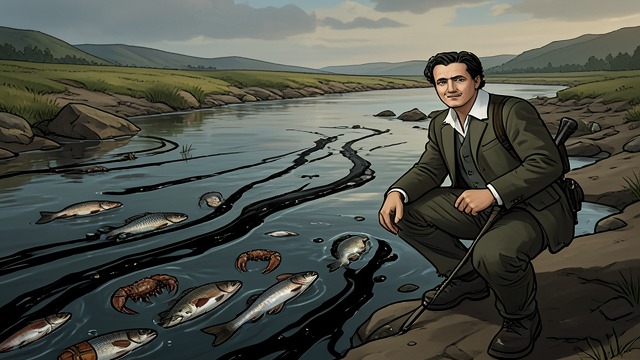
Pesticides applied to farms and forests enter rivers through runoff and drainage. The chemicals travel toward estuaries and coastal waters even when no shoreline spraying occurs.
Limited Detection
Carson notes that investigators often cannot identify every compound after dilution and chemical change. The lack of reliable tests leaves the scale of marine contamination uncertain.
Salt Marshes Are Sprayed
Direct Exposure
Marsh Treatment
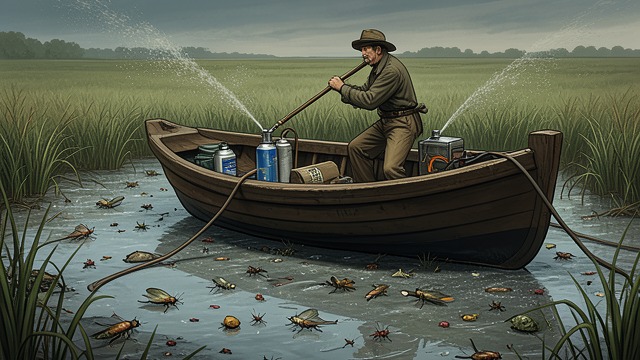
Salt marshes and inlets were sprayed to control mosquitoes, bringing insecticides directly into habitats used by fish and crustaceans. Repeated treatments could expose the same waters many times.
An Ecological Unit
Carson emphasizes that marshes, estuaries, and bays form connected nursery and feeding grounds. Their importance extends beyond the visible shoreline to the future of fisheries.
Fish and Crabs Die
A Marsh Kill
Dieldrin’s Immediate Effect
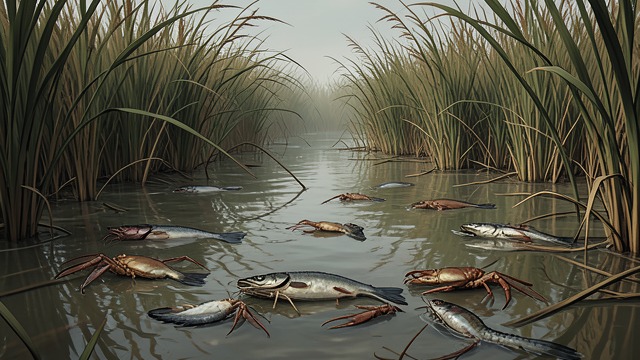
Treatment of salt marsh in St. Lucie County with dieldrin was followed by a substantial fish kill and near destruction of crustaceans. The scale of the mortality made the effect impossible to dismiss as subtle.
A Food-Web Gap
Crabs and other organisms were part of the food supply for birds and larger animals. Their loss threatened ecological functions as well as species directly valued by people.
Young Marine Life Is Vulnerable
The Fragile Stages
Shrimp and Fish Nurseries
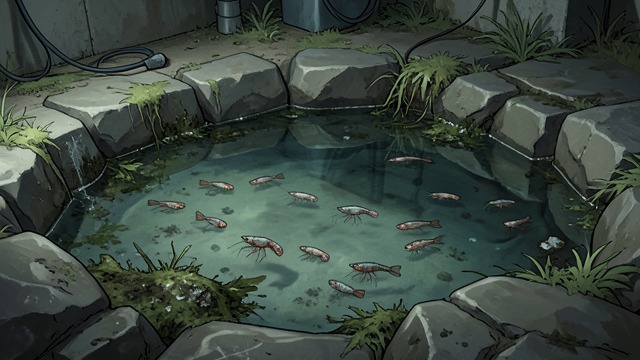
Young fish and commercial shrimp depend on protected inshore waters for feeding and development. Early life stages can be more sensitive to pesticides than adults.
Small Concentrations Matter
Laboratory tests described by Carson found that very low concentrations of some insecticides harmed young shrimp. Dilution alone could not guarantee safety for organisms with extreme sensitivity.
Shellfish and Human Food

Contamination Reaches the Table
Plankton and Larvae
Oyster and clam larvae depend on plankton and can be harmed by minute pesticide concentrations. Adults may accumulate chemicals in tissues even when they show less obvious direct injury.
A Human Parallel
People who eat shellfish may receive contaminants concentrated by aquatic organisms. Carson warns that marine food webs can reproduce the same transfer patterns already observed on land.
As agricultural runoff enters major rivers
During mosquito-control campaigns of the 1950s
Spring 1955
In the discussion of coastal species
At the end of Chapter 9
